2025 Test Update
What Changed in the 2025 Civics Test?
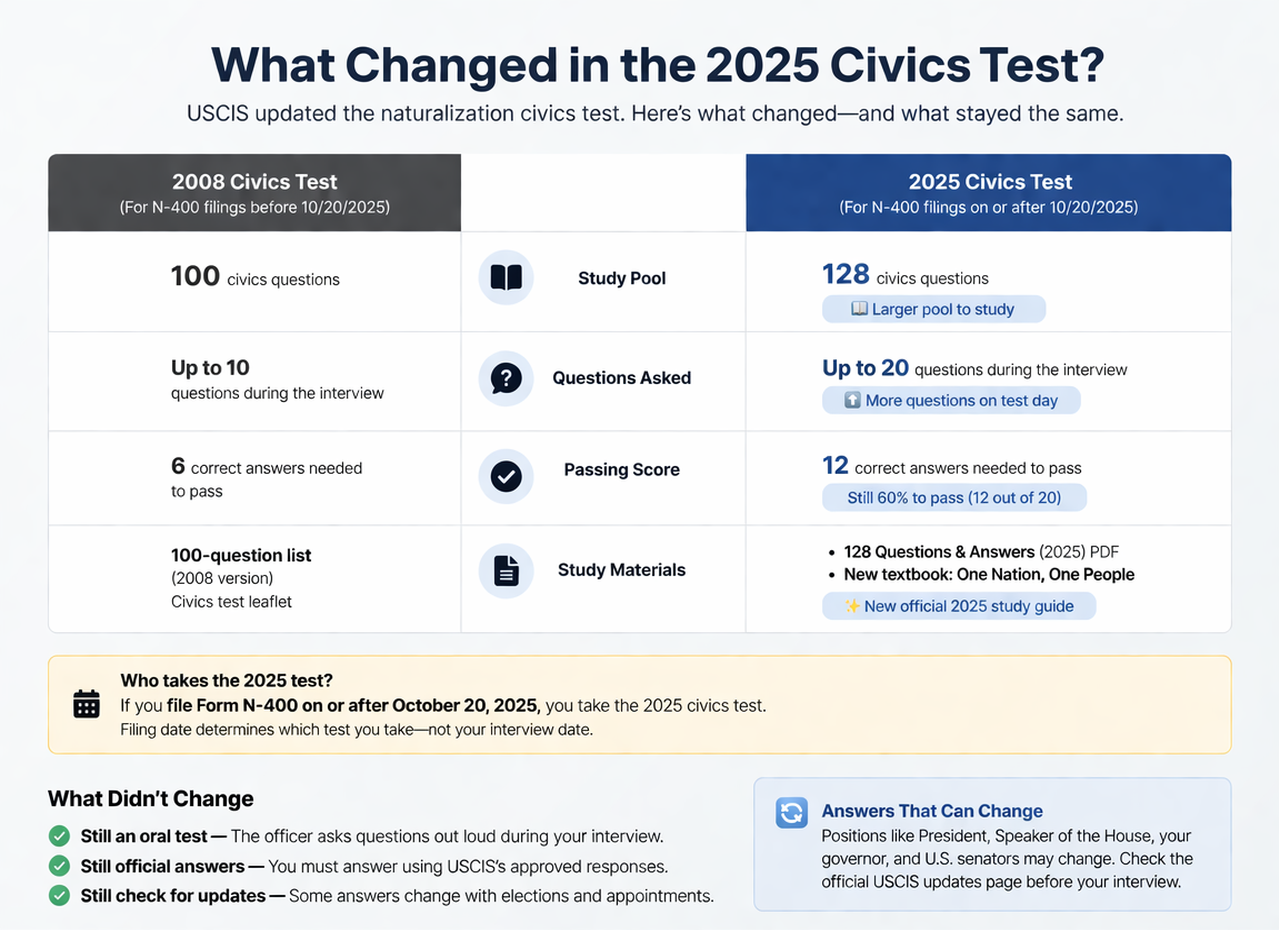
Yes, the 2025 civics test changed in a few important ways. The biggest change is simple: the official study pool is now 128 questions instead of 100. The officer can ask up to 20 questions instead of up to 10, and you must answer at least 12 correctly instead of 6 to pass the civics portion. USCIS also states that the 2025 test applies to applicants who file Form N-400 on or after October 20, 2025.[1][2]
That is the short answer. The more useful answer is what those changes mean for your study plan.
The biggest changes at a glance
Under the older 2008 civics test, USCIS published 100 civics questions, asked an applicant up to 10 during the interview, and required 6 correct to pass. Under the 2025 civics test, USCIS publishes 128 questions, asks up to 20, and requires 12 correct. Both versions are described by USCIS as oral civics tests, which means the officer asks the questions out loud during the naturalization interview.[1][3]
So the main change is not that USCIS turned the civics exam into a different kind of test. The bigger shift is that applicants on the 2025 version have a larger pool to study and should expect more questions during the interview. That raises the study burden even though the pass threshold still works out to 60 percent. The 2008 version required 6 out of 10 correct, and the 2025 version requires 12 out of 20 correct.[1][3]
Who takes the 2025 test?
This is where many people get confused.
USCIS states that applicants who file Form N-400 on or after October 20, 2025 must take the 2025 Naturalization Civics Test. That means the filing date matters. It is not simply about when your interview happens or when you started studying.[2]
Because USCIS can revise policy pages and testing guidance, this is one of the facts that should be checked again before publishing and reviewed periodically afterward. But as of the USCIS materials used here, the official rule is tied to the N-400 filing date.[2]
What changed in the content itself?
The safest way to explain this is: the 2025 test is broader and more built around the new official 128-question set and 2025 study materials. USCIS published a dedicated 128 Questions and Answers (2025 version) document and a separate textbook-style study guide, One Nation, One People, for the 2025 version.[1][4]
For self-studiers, the practical takeaway is this: do not assume that old 100-question flashcards fully cover the new test. Even if many core civics themes still overlap, USCIS now expects preparation from the official 128-question pool for the 2025 version.[1]
The 2025 study guide also signals a more structured content framework. Its chapters cover core government branches, rights and responsibilities, geography, early American history, the Revolutionary War, the Civil War, later American history, and symbols and holidays. That does not mean every chapter is a separate section on interview day, but it does show how USCIS wants applicants to study the new version.[4]
What did not change?
A few things are easy to overstate, so it helps to be precise.
The civics portion is still an oral test run by a USCIS officer during the naturalization interview. USCIS still publishes official acceptable answers. And USCIS still warns that some answers can change over time because of elections or appointments.[1]
So while the 2025 version is different, it is not a mystery test. It is still a study-from-the-official-materials test.
One part of the 2025 test is still dynamic: current officials
This matters a lot.
USCIS says some answers may change because of elections or appointments, and applicants should check the official USCIS updates page for answers that may have changed. USCIS also says you must answer with the name of the official serving at the time of your naturalization interview.[1][5]
That affects questions tied to people in office, such as the President, Vice President, Speaker of the House, Chief Justice, governor, senators, and U.S. representative. This is one reason self-studiers should not memorize those answers once and forget them.
A practical habit is to re-check current officials shortly before your interview date.
What these changes mean for self-study
If you are taking the 2025 test, the smartest adjustment is not panic. It is study structure.
First, study from the official 128-question set, not just older 100-question materials. Second, practice answering questions out loud, because the civics test is oral. Third, build in a final review of any answer that depends on a current officeholder.[1]
This is where a tool like United For Citizenship can help in a way the PDF alone cannot. The official USCIS materials are the authority. U4C's value is in helping you turn those materials into practice: spoken mock interview work, weak-area review, and reminders to refresh answers that can change before interview day.
What to do next
- Confirm which civics test version applies to you based on your N-400 filing date.[2]
- If you take the 2025 test, study from the official 128-question USCIS materials.[1]
- Practice answering aloud, not just reading silently.
- Re-check current officials close to your interview date.[5]
- Take the Free Readiness Check to see which topics still need work.
FAQ
Is the 2025 civics test harder?
USCIS does not label it "harder" in the official materials used here. What can be said from those materials is that the study pool is larger and the officer may ask more questions during the interview. Whether that feels harder depends on how well you prepare for the broader question set.[1]
Can I use 2008 civics materials to prepare for the 2025 test?
Not by themselves. The 2008 materials reflect the older 100-question version. If USCIS requires you to take the 2025 test, your main study source should be the official 128 Questions and Answers (2025 version) and related 2025 USCIS study materials.[1][3]
What about the 65/20 special consideration?
For the 2025 version, USCIS says that applicants who are 65 or older and have been lawful permanent residents for 20 years or more may study only the 20 questions marked with an asterisk. USCIS says the officer will ask 10 out of those 20, and the applicant must answer at least 6 correctly.[1]
Do I need to re-check names like the President and Speaker before my interview?
Yes. USCIS explicitly says that some answers may change because of elections or appointments and that you should answer with the official serving at the time of your interview.[1][5]
References
- U.S. Citizenship and Immigration Services (USCIS), 2025 Civics Test: 128 Questions and Answers, M-1778 (09/25). https://www.uscis.gov/sites/default/files/document/questions-and-answers/2025-Civics-Test-128-Questions-and-Answers.pdf
- U.S. Citizenship and Immigration Services (USCIS), USCIS Policy Manual, Volume 12, Part E, Chapter 2: English and Civics Testing. https://www.uscis.gov/policy-manual/volume-12-part-e-chapter-2
- U.S. Citizenship and Immigration Services (USCIS), Civics Questions and Answers for the 2008 Naturalization Test. https://www.uscis.gov/sites/default/files/document/questions-and-answers/OoC_100_Questions_2008_Civics_Test_V1.pdf
- U.S. Citizenship and Immigration Services (USCIS), USCIS 2025 Civics Test Study Guide: One Nation, One People. https://www.uscis.gov/sites/default/files/document/brochures/USCIS-2025-Civics-Test-Study-Guide.pdf
- U.S. Citizenship and Immigration Services (USCIS), Check for Test Updates. https://www.uscis.gov/citizenship/find-study-materials-and-resources/check-for-test-updates